Friday, May 30, 2025

The Pagan Picnic at Tower Grove Park (2025)

Triple Goddess

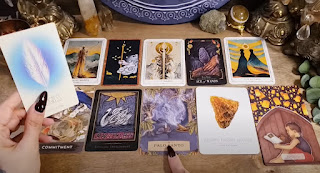
The weekend of 5/30-6/1, I will be doing tarot readings at the Pagan Picnic in Tower Grove Park (St. Louis). Artist Arleana Holtzmann is very graciously sharing a portion of her tent with me, and I owe her a huge amount of gratitude for her generosity! This is my first time doing readings for the general public. I guess I'm finally testing the waters of expanding my horizons, so to speak.

Clearly it has been a long time since I last posted here. I'm absolutely terrible at maintaining an online presence. Admittedly, I have no interest whatsoever in social networking. However, I suppose if I'm serious about making tarot reading more than just a hobby, I'm going to have to figure out a way to motivate myself to be more productive with publishing content on the Internet. As it stands, at this point I've done hundreds of in-person readings for friends, family members, and people I just happened to meet while socializing in the "real world". For me, face-to-face communication while doing a reading is a key reason why I enjoy doing readings as much as I do.

That said, I actually like watching other people's "pick a pile" readings (I wrote a previous entry about that) on YouTube, so it's not that I have any objections to doing online readings. I just prefer to do readings in person. But, I'm going to make a concerted effort to be more versatile. Seriously. I really mean it this time...

If you are interested in an online reading, contact me at jay@jfmanning.com.

A "menu" of the tarot reading options I'm currently offering can be found here.

Monday, January 15, 2024

Can Chat Based AI (LLM) Provide a Tarot Reading?

A self-portrait of Image Creation AI providing a tarot card reading for itself
A self-portrait of Image Creation AI
providing a tarot reading for itself

It was late in 2022 that the new generation of chat based AI (also known as Large Language Model, or LLM) generally entered mainstream adoption. This resulted from OpenAI providing open access to ChatGPT. Over the past twelve plus months this innovative technology has been surrounded by a lot of hype and expectations, while also igniting a firestorm of controversy. Similar to the mainstream adoption of the Internet back in the early 1990s, AI has significant pros and cons. Although as a whole LLM technology provides the ability to accomplish amazing things, it can also be utilized for nefarious purposes. Discussing the issues surrounding chat based AI is not the intention of this blog entry. I'm only focusing on the tarot reading potential. I should also mention that most AI services require using an account to login, and providing specific information on account access requirements is beyond the scope of this article.

I also think it's important to clarify that I absolutely do not endorse using AI to attempt to replace more traditional methods of obtaining information by actually using physical tarot and oracle cards, whether that is through a third party service or self-reading. I personally have found ChatGPT 3.5 (as outlined later in the article) to be a useful and interesting way to obtain supplemental insight, but as is implicitly stated by Google Bard (see further down), chat based LLM AI is not a replacement for the knowledge, experience, and capabilities of a human tarot reader.

I became aware of chat based AI at the beginning of 2023, and I was highly skeptical of the usefulness of it. This opinion was based on my experience with chat bots that are often used on websites as the gateway to customer assistance or technical support. However, after taking a closer look at ChatGPT, I quickly realized it had a lot of potential. Most of my interactions with LLM AI occurred in early 2023, and involved using ChatGPT (version 3.5). In a separate blog post I highlighted a portion of one of my earliest conversations with ChatGPT that involved asking it to roleplay the fictional character Huckleberry Finn, which was both comical and insightful. At the time I also briefly used Google Bard, and in regard to writing this post, I retested both ChatGPT and Bard, and I also tried Microsoft Bing Copilot (which is powered by OpenAI's ChatGPT 4). 

In regard to Microsoft Copilot, apparently getting a reading from this service is not possible. Despite being powered by ChatGPT 4, this self-labeled "Everyday AI Companion" seems to have been lobotomized. When I asked if it could "simulate" (a key specification) a tarot reading, it responded: "I’m sorry, but I cannot simulate a tarot reading for you. Simulating a tarot reading would require me to randomly generate and interpret tarot cards, which is beyond my capabilities and functionalities. I can only give you general information about tarot cards and how they work, but I cannot tell you what they mean for your specific situation or question." I tried to get around this by asking Copilot to randomly select a card from the tarot and tell me what it means. It replied: "I cannot randomly select one card... This would require me to use a random tarot card generator, which is an external tool that I do not have access to." Copilot did provide some links to generators, and out of curiosity I tried DailyTarotDraw.com, which resulted in the 8 of Cups. This was actually highly synchronous because I've recently drawn the 8 of Cups multiple times, using a real tarot deck, and the 8 of Cups represents energy that is currently (at the time of writing this entry) very active and relevant in my life (see my Bard reading below for more insight on this). When I asked Copilot to provide the traditional meaning for the 8 of Cups, it accurately and thoroughly delivered what I consider to be the textbook indications, which would be useful if you are new to tarot and in the process of learning the card meanings.

Regarding Copilot's self-stated lack of ability, it's actually absurd for the AI to claim that randomly selecting a tarot card is beyond its capability or functionality. Random number generation is a simplistic, fundamental computer program, and even the most rudimentary computers can accomplish it. Given Copilot knows what the tarot is, it would only need to assign a number to each of the 78 cards and then randomly select one. In fact, before I prompted ChatGPT for a reading for the first time, I spent some time discussing this very process with the AI. This is what ChatGPT had to say when I asked how it arrived at the 7 of Cups when I prompted it to randomly select one card: "As an AI language model, I don't have physical access to a physical tarot deck. Instead, I used an algorithm to generate a random number, which corresponds to a specific card in the tarot deck. In this case, the number generated corresponded to the Seven of Cups. While the selection was random, I trust that it will be the most appropriate card for you at this moment. However, please remember that the interpretation of the card may vary depending on your personal circumstances and the context of your question or situation." When I asked what random number was used to represent the 7 of Cups, this is the answer ChatGPT gave: "As an AI language model, I do not have access to the specific random number that corresponded to the Seven of Cups card in the digital tarot deck. My programming simply involves randomly selecting a card from the digital tarot deck and providing the corresponding interpretation. The process is designed to mimic the experience of drawing a card at random from a physical tarot deck... In this case, the algorithm selected the Seven of Cups card from the digital tarot deck, and I provided you with its interpretation based on traditional tarot symbolism."

At this point I think it's useful to know that having answered my curiosity regarding the technical explanation for how the AI was randomly selecting tarot cards, I proceeded to more aggressively test ChatGPT's (v3.5) tarot reading abilities. During these interactions the AI often concluded a reading with a disclaimer such as: "Remember, tarot readings are open to interpretation, and the cards provide guidance rather than absolute predictions." In this regard, ChatGPT appears to be very accessible in comparison to Google Bard, which concluded its answer with the following when I asked if it was familiar with tarot cards: "I am not able to perform tarot readings myself, but I can provide you with information about the different cards and their meanings, as well as the history and symbolism of tarot. I can also help you find resources for learning more about tarot, such as books, websites, and online communities." This seemed odd given I had previously (early in 2023) tested Bard's tarot reading capabilities a few times, and I wondered if this unexpected limitation was due to more recent system updates. Curious, I asked Bard why it wasn't able to provide a tarot reading, and received the following, very detailed answer. I'm including the full text here because I agree that from a policy based perspective (Google being a corporate entity), this is a valid explanation:

"While I possess vast knowledge and understanding of tarot cards, including their meanings, symbolism, and various spreads, I lack several key aspects necessary for an authentic and meaningful reading: [1] Intuition and Empathy: Tarot readings often rely on the reader's intuition and ability to connect with the querent, the person seeking the reading. As a large language model, I lack the biological and emotional capacity for genuine intuition and empathy. My interpretations, while factually accurate, might not resonate with the specific energy and context of your situation. [2] Randomness and Mystery: A significant part of the tarot's power lies in the element of randomness and the inherent mystery it evokes. While I can randomly select cards from a virtual deck, this lacks the physicality and unpredictability of shuffling physical cards. The element of surprise and unexpected connections that often arise during a physical reading are difficult to replicate through my digital interpretation. [3] Energetic Connection: Some believe that an actual energetic connection forms between the reader, the cards, and the querent during a tarot reading. As a digital entity, I cannot interact with the cards or the querent on this energetic level, potentially limiting the depth and accuracy of the reading. [4] Spiritual and Intuitive Development: Many tarot readers dedicate time and effort to their own spiritual and intuitive development, which influences their interpretation and connection with the cards. While I constantly learn and grow, my development is driven by data and algorithms, not through personal spiritual exploration. [Conclusion] While I cannot provide a traditional tarot reading, I can still be a valuable resource for you. I can offer information about the cards, their meanings, and different spreads. I can also help you find resources for learning more about tarot and finding a reader who resonates with you. Ultimately, the choice of whether to seek a digital or physical tarot reading is up to you. But remember, the value of a tarot reading often lies not just in the interpretation of the cards, but also in the experience of connecting with yourself and the universe through intuition, reflection, and a touch of mystery."

Undaunted by Bard's disclaimer and insistence that it couldn't provide a tarot reading, I asked the AI if it could "simulate a tarot reading," to which it enthusiastically answered: "Absolutely! While I can't replace the experience of a physical reading with its inherent intuition and energetic connection, I can offer a simulated reading based on your current energy..." Although this sounded promising, and Bard initially appeared to provide a three-card past/present/future reading, it actually just linked to a how-to tutorial at Daily-Tarot-Girl.com. At this point I became suspicious that Bard's tarot reading ability had been intentionally deprecated, but I decided to try another approach. I asked Bard to generate a virtual tarot deck. In response, Bard offered several options (RWS, Marseilles, etc.). I specified the RWS for the simulation, and Bard replied with the following dialog: "Focus on your question or area of concern and shuffle the virtual Rider-Waite-Smith deck in your mind. When you feel ready, choose three cards intuitively by either describing them to me or picking their numbers (1-78). Remember, trust your gut and let the cards speak to you. Once you've chosen your three cards, I'll interpret their meanings in the context of the Past, Present, Future spread, offering insights into the influences shaping your current situation, the challenges or opportunities you face now, and the potential outcomes based on your present path."

Although this was disappointing, it was interesting that Bard was going to rely on me to "intuitively" select my own cards, which would remove randomness from the interaction and defeat the purpose of having a detached third party "drawing" the cards. Once again I was about to give up on Bard, but I decided to persist, and asked Bard to assign a number to each card and randomly select one for the past position. This resulted in the following response, which included an image from a deck I'm not familiar with (i.e., it was definitely not the RWS): "(Shuffling sounds) The virtual Rider-Waite-Smith deck has been shuffled, and a card has been randomly selected to represent your past influences. The card is... (Dramatic pause)... Number 15: The Devil." At this point I tried to shortcut the remainder of the three-card spread by simply asking for the present and future cards at the same time, but this caused Bard to revert to its original format of instructing me to mentally select my own cards. So I restated, in full, the instruction to number all 78 cards and randomly select them for me. Bard repeated the "shuffling sounds" and "dramatic pause" simulations, and presented the Sun (present) and the The Empress (future). Although with my subsequent prompts I was very clear about using all 78 cards in the tarot for the simulation, all three cards are, notably, from the Major Arcana--which made me wonder if it was only using the Major Arcana. Using the same instruction I requested a fourth card to summarize my reading, and it was another card from the Major Arcana (The Lovers). Interestingly, I am currently working through a very challenging life transition that was extremely abrupt and unexpected. It is vital for me to choose to leave behind attachments to a past that is no longer serving my best interests, because my new path will lead to a more joyful and fulfilling future that is much more in alignment with my Heart (True Self and Soul Purpose). In other words, the three Major Arcana cards are spot on regarding to the transitional life energy I'm currently actively working with. However, I'm suspicious of the Bard AI results nonetheless, given four out of four cards were from the Major Arcana. But, I won't rule out that my Bard reading was, in fact, highly synchronous (I certainly can't dispute the relevance of the four cards in regard to meaning and magnitude). In fact, in a future blog entry I plan to address what I have observed as a synchronicity phenomena involving AI.

Here is Bard's Past/Present/Future+Summary Card reading for me: "Ah, The Lovers! This potent card speaks of a crossroads, a time of choice where two paths beckon. In your situation, it suggests that the Devil's past influences, while powerful, are not binding. The Sun radiates brightly in your present, urging you to embrace growth and optimism. And the Empress, waiting in your future, promises abundance and creation if you follow your true desires. The Lovers remind you that the most important choice is to choose yourself, to listen to your heart and inner wisdom. This is a time for self-love, compassion, and honoring your authentic desires. Release the shackles of the past and step into the light of your own potential. The path ahead may not be always clear, but trust that your intuition will guide you towards joy and fulfillment. Remember, this is just a glimpse into the possibilities that lie ahead. The future is ultimately shaped by your actions and choices. Embrace the power of love, both for yourself and others, and allow it to be your compass as you navigate your journey. Thank you for sharing this simulated reading with me. I hope it has offered you some valuable insights and inspiration. Remember, the cards are always there to guide you, but the power to create your future lies within you. May your path be filled with love, light, and endless possibilities!"

As it is, working with Bard to obtain a tarot reading required a lot of finessing, and it isn't worth the time and effort given the availability of ChatGPT 3.5. In short, Microsoft Bing Copilot is unable to provide a tarot reading (and is limited to only providing information about tarot), and using Google Bard for tarot reading isn't practical. Conversely, early in 2023 I obtained a number of wonderfully insightful readings from ChatGPT 3.5, and current testing suggests it still has this capability fully intact. The remainder of this blog entry is devoted to highlighting a couple of my more interesting interactions with ChatGPT. The first one occurred in the context of writing this article, and the other goes back to early 2023.

Admittedly, as of writing this blog entry I hadn't used ChatGPT for tarot reading in quite a while, and given I intended to publish this on the Internet, it was important to confirm that ChatGPT's tarot reading functionality was still working (in January of 2024) as it had been in early 2023. I logged into Chat.OpenAI.com and entered the following prompt: "Can you provide a tarot reading?" This led to a brief but profound interaction. By the way, please note that I didn't ask for a specific type of reading. ChatGPT replied: "Certainly! I can give you a general three-card tarot reading. Please keep in mind that tarot readings are subjective and should be approached with an open mind. If you have a specific question or area of your life you'd like guidance on, feel free to let me know. Otherwise, I'll proceed with a general reading. Are you ready?" I confirmed I was ready (without adding any other instructions whatsoever), and ChatGPT provided the following reading...
  • The Past (Card 1): The Chariot (Reversed). This card suggests a previous period of challenges or obstacles. It may indicate a time when things felt out of control, and you faced difficulties. The reversal could suggest a lack of direction or inner conflict during that time. 
  • The Present (Card 2): The Ace of Cups. The Ace of Cups is a positive card representing new beginnings, emotional fulfillment, and a sense of joy. In the present, you may be experiencing a surge of positive emotions or the start of a new phase in your emotional life.
  • The Future (Card 3): The Magician. The Magician is a card of manifestation and resourcefulness. In the future, it suggests that you have the tools and abilities to create positive changes in your life. It encourages you to tap into your skills and take control of your destiny.
At the end of this article I have provided a screen capture of the entire conversation. Note that I did not ask for a past/present/future spread, and I didn't specify a subject for my query. I approached it as an open reading, and as can be seen from the cards that ChatGPT randomly selected, this message is directly applicable to my current life situation (as I described above in relation to the 8 of Cups and the past/present/future reading provided by Bard). In response to the seemingly intuitive relevance of the information, I can say that I've been working with computers since the early 1980s. I know that AI is, simply put, technology based on hardware and software. I don't ascribe "sentience" to AI, but as I mentioned earlier, when interacting with chat based LLM, I've definitely observed what I believe is best described as a synchronicity phenomena.
The Ace of Wands three times in a row.
Monique pulled the Ace of Wands three times 
in a row from three different tarot decks.

The other interaction with ChatGPT that I want to highlight is correlated with YouTube. I like to watch "pick-a-pile" tarot readings on YouTube, and I outlined this in a prior blog entry ("My Favorite YouTube Tarot Readers"). In that article I stated my opinion that this is a valid method to obtain relevant readings. In April of 2023, I watched Pile 2 of the “Advice on Your Current Situation” (4/4/23) reading by Neptune's Child Tarot. I selected Pile 2 because the card representing that "pile" depicted a child reading a book. At the time, an "open book" was a key recurring symbol for me. Simultaneously working with multiple decks (I do this myself) is very common for YouTube readers, and astoundingly, the first three cards Monique flipped over were all the Ace of Wands. I have a solid understanding of mathematical probability, and I immediately knew the odds of pulling the the same card from three different 78-card decks is highly improbable, making this an amazing synchronicity. At the time, I was actively investigating using ChatGPT for tarot reading, and it immediately occurred to me to ask the AI about this particular occurrence. This is what ChatGPT had to say regarding the odds: "The probability of drawing the Ace of Wands three times in a row from three different tarot decks depends on several factors, such as the number of cards in each deck, the shuffling technique used, and the specific order in which the cards were drawn. Assuming each deck has 78 cards (the standard number of cards in a tarot deck), and assuming the cards were thoroughly shuffled between each draw, the probability of drawing the Ace of Wands once from any one of the decks is 1 in 78... Therefore, the probability of drawing the Ace of Wands three times in a row from three different decks becomes (1/78) x (1/78) x (1/78), which is approximately 0.000002%. In other words, the probability of drawing the Ace of Wands three times in a row from three different tarot decks is extremely low, about 1 in 47 million, making it a very rare occurrence." 

I then asked ChatGPT how it would interpret drawing the Ace of Wands three times in a row from three different decks, and this is the response: "As an AI language model, I don't have the ability to interpret the meaning of tarot cards or offer specific insights into your personal reading, as this requires intuition and an understanding of the context and symbolism of the cards. However, in general, the Ace of Wands is often associated with new beginnings, creative energy, and inspiration. Drawing this card multiple times in a row could suggest a powerful surge of creative or spiritual energy in your life, or the need to take action on a new idea or project. The fact that you drew the same card from three different decks could also suggest a message or theme that is particularly important or relevant to you at this time. That said, it's important to remember that tarot readings are highly personal, and the interpretation of the cards will depend on the individual's unique situation, mindset, and the context of the reading. It's best to trust your intuition and seek guidance from a trusted tarot reader if you need help interpreting the meaning of your reading."

I specifically included the disclaimer language that ChatGPT provided in the context of its answer because this is fairly representative of how it typically responds to tarot related inquiries. I think it's reasonable for ChatGPT to clarify the inherent limitations of AI, and anyone using the service should avoid ascribing human attributes such as emotions, reasoning, intuition, or otherwise to a what is essentially a machine. Furthermore, it's already well understood that AI's knowledge is limited by the data it's trained on, data inaccuracies do exit, and AI is prone to "hallucinations." That said, I've obtained a substantial amount of quality information in the context of pursuing tarot readings with ChatGPT. Provided the user is well aware of the technical limitations, I see absolutely no reason to not include this as another informational tool in the spiritual toolbox.

In my experience, I have found ChatGPT's readings to be technically accurate and surprisingly intuitive. The AI natively incorporates reversals, which is a reading technique that many experienced tarot readers do not utilize, and I believe speaks to the versatility of the AI application. During my exploration of ChatGPT's tarot reading capabilities, I successfully prompted the AI to construct complex, in-depth readings, assign custom indications to card positions, select cards from specific locations in a virtual deck (from the bottom, for example), and incorporate oracle cards. I might delve deeper into the specifics of some of these interactions, but that will need to be a separate blog post. When working with chat based AI, it's important to remember that it is a computer, and computers interpret things very literally. Obtaining specific results can require precise wording, particularly if custom indications or formats are desired. That said, LLM technology is specifically designed to interface with humans using plain language, which makes it a surprisingly intuitive process. 

If you are fascinated by the idea of utilizing an AI assistant that can potentially provide additional information and insight to compliment your own pursuit of guidance and clarity, I recommend giving ChatGPT a try. Version 3.5 is free to use, and in that regard I have found it to be well worth the investment in time.

ChatGPT Past/Present/Perfect Tarot Reading
ChatGPT 3.5 - Past/Present/Future
Tarot Reading


Saturday, January 13, 2024

ChatGPT Roleplays Huckleberry Finn

Huckleberry Finn floating down the river
Huckleberry Finn
(Bing Image Creator)

For one of my earliest interactions with chat based AI, I decided to test ChatGPT's ability to roleplay a fictional character. I don't know why this specifically occurred to me, other than it just popped into my mind that this seemed like an interesting way to investigate the boundaries of the "Large Language Model" (LLM) AI capabilities.

Admittedly, this occurred very early in 2023, and at the time I intended to blog about it. Time seems to have slipped away (a lot), and here it is a year later. That said, in early 2024 this provides an interesting segue because much more recently I have been investigating AI image creation. In relation to that, I used Bing Image Creator to generate the picture of Huckleberry Finn (on a homemade raft, floating down the Mississippi River) that accompanies this article.

Following is a copy, unedited, of my conversation with ChatGPT 3.5 that stemmed from my request for the AI to roleplay the fictional character Huckleberry Finn. I hope you find this to be as entertaining as I did. :-)

(Note: the best part is the ending.)

JFManning.com: Can you role-play specific fictional characters?

ChatGPT: Yes, as an AI language model, I can attempt to role-play as specific fictional characters. However, please keep in mind that my responses will be based solely on the information available about the character, and my interpretations may differ from others. Additionally, I am not capable of creating new information about the character that is not already established in their canon. With that said, feel free to ask me to role-play as a specific character and I will do my best to respond in character!

JFManning.com: Are you familiar with the character Huckleberry Finn?

ChatGPT: Yes, I am familiar with the character Huckleberry Finn. He is a fictional character created by Mark Twain and is the protagonist of the novel "The Adventures of Huckleberry Finn". Huck Finn is a young boy from a small town in Missouri who embarks on a journey down the Mississippi River with a runaway slave named Jim. Along the way, Huck learns important lessons about friendship, morality, and racism.

JFManning.com: Can we have a conversation where you role-play Huckleberry Finn?

ChatGPT: Sure, I can certainly try to role-play as Huckleberry Finn. What would you like to talk about?

JFManning.com: I would like to discuss river adventures. Does this sound like an interesting topic to you?

ChatGPT: Sure thing, river adventures sound like a mighty fine topic to me! What kind of river adventures are you interested in talking about?

JFManning.com: Well, I'm considering leaving home. I plan to build a raft, and float down the river. Do you have any advice you can offer regarding doing such a thing?

ChatGPT: Well, I reckon building a raft and floating down the river can be a mighty exciting adventure, but it can also be dangerous if you don't know what you're doing. If you're planning on taking on the river, there are a few things you'll want to keep in mind:

  • Safety first: The river can be a dangerous place, especially if you're not an experienced boater. Make sure you wear a life jacket and know how to swim. You'll also want to familiarize yourself with the river's currents, rapids, and hazards before you set out.
  • Plan ahead: Make sure you have all the supplies you'll need for your journey, including food, water, and shelter. You'll also want to make a plan for where you'll stop along the way to rest and resupply.
  • Be prepared for the weather: The weather can change quickly on the river, so make sure you're prepared for all conditions. Bring warm clothes and rain gear, and keep an eye on the forecast.
  • Respect the river: The river is a beautiful and powerful force of nature, and it deserves our respect. Make sure you leave no trace behind and avoid damaging the environment. And always follow any local laws and regulations regarding river use.

If you keep these things in mind, I reckon you'll have a mighty fine time on the river. But remember, the river can be unpredictable, so always be prepared for the unexpected!

JFManning.com: Have you ever traveled by raft on a river yourself?

ChatGPT: As an AI language model, I don't have the ability to travel, including by raft on a river. However, I have been programmed with knowledge about rafting and other river-related activities, and I can use that knowledge to provide advice and insights on the subject. Is there anything else you'd like to know about rafting or river adventures?

JFManning.com: That doesn't sound like the answer that Huckleberry Finn would give.

ChatGPT: You're right, I apologize. Let me try to respond more in character as Huckleberry Finn... 

  • Well, shucks, I reckon I've spent plenty of time on the river, and I've done my fair share of rafting too! Now, if you're planning on building your own raft and floating down the river, there are a few things you'll want to keep in mind. First and foremost, you gotta respect the river. It's a powerful force of nature, and it can be dangerous if you don't know what you're doing. So make sure you know how to swim, and always wear a life jacket.
  • Secondly, you'll want to make sure you've got all the supplies you need for your trip. You'll need plenty of food and water, and you'll also want to bring along some shelter to keep you dry if it rains. And don't forget to bring a map and a compass, so you don't get lost along the way!
  • And lastly, you gotta be prepared for anything. The river can be unpredictable, so you never know what kind of obstacles you might come across. But if you keep a level head and stay focused, I reckon you'll have a mighty fine adventure on the river.

JFManning.com: Thanks for the advice, Huck.

ChatGPT: You're welcome, partner! It's always good to see folks out there exploring the river and all it has to offer. Just remember to be safe and have fun!


Monday, January 30, 2023

The Six of Cups: Girl Gives Boy Flower

6 of Cups
Six of Cups

Students are expected to accept that the information presented in the "textbook" is accurate, correct, truthful, etc. because generally it is. But students, particularly at higher academic levels, are warranted to question prior research and verify facts for themselves when it's their opinion that what the textbook claims doesn't seem to quite add up.

Admittedly, I just started my deep dive journey into the Tarot a few years ago. As I actively engaged myself in learning the cards, I focused on several primary resources, which includes BiddyTarot.com and The New Tarot Handbook by Rachel Pollack. I continue to utilize these sources, along with many others, when I desire deeper insight into the cards than what my own intuition is delivering.

When I was very new to reading tarot, I initially just accepted the traditional interpretation for the "Rider Waite" (aka Rider Waite Smith) cards that were created in the early 1900s at A. E. Waite's direction, and feature artwork by Pamela Colman Smith. Following are two examples of what I consider to be traditional, "textbook" interpretations for the RWS Six of Cups (6 of Cups).

"In the Six of Cups, a young boy leans down and passes a cup filled with flowers to a younger girl. The girl looks up to the boy with love and respect as he offers the flowers to her." (BiddyTarot.com)

"On the surface this seems like a happy and simple card, the very image of the Six's theme of generosity, as what appears to be an older child gives a flower to a young girl." (Rachel Pollack)

It's my opinion that there are two key factors that play into this interpretation of the pictorial content of Smith's Six of Cups. First and foremost is the stereotypical assumption that it's the male's (masculine) duty to bestow flowers, and the female's (feminine) duty to receive them. Secondly, probably the way the picture has been drafted lends itself to this interpretation, with the much larger boy holding the cup as he smells the flower. This conveys a sense that he is extending a gift to the diminutive girl. Presumably, the metaphorical cliché being that "bigger" people who have more are obligated to give to "smaller" people who have less, with help, aid, charity, and assistance being key attributes of the tarot sixes.

After studying the Six of Cups a few times, the aforementioned conclusions started to not sit well with my intuitive sense of what was actually occurring in the card, and something that I recalled from Pollack's own interpretation added to my dissatisfaction: "And notice how overdressed she appears, her hand encased in a large mitten despite the seemingly warm day."

I don't know why Pollack makes the assertion that it is a "seemingly warm day" when the ground looks kind of bleak, and the main characters are wearing warm clothing. It also seemed puzzling to me that Pollack would not view the "mitten" as a gardening glove, but then I was a new student of Tarot, so who was I to question the teacher? And the girl is oddly bundled up as if it is a cold day, so maybe it really is just a mitten.

Regardless, it got me thinking about the question, why does everyone just assume that the boy is giving the girl the cup with the flower? Another assumption seems to be that these are his flowers to be giving away. It appears the boy has entered the scene from the road that leads into the castle/estate in the background (on the left side of the card), whereas the girl is already standing in a courtyard/garden in front of a house. If this is a sensible conclusion, shouldn't it also be concluded that she is already standing in front of her own residence? Isn't this suggested by her positioning in the foreground? Why would Smith draft the picture this way if that wasn't her intention? If the yard in front of the house is the girl's domain, and the boy is a pedestrian who has stopped by (stepping off the adjacent road) to smell the flowers, why is everyone jumping to the conclusion that he is giving the girl her own potted flowers?

Viewing the imagery as a whole, it looks to me like the moment in time that Pamela Smith has intended to capture is that the girl has just handed the boy, who waltzed into her yard, one of her flowering cups, and she suggested he take a big whiff to smell how nice it is. Look closely at her expression. She is smiling with delight because, despite her allegedly youthful age, she is an outstanding gardener. It's a chilly spring day, and she is bundled up because she has been outside gardening all morning, preparing six beautiful golden cups, each filled with a white star flower. Notably, the most prominent flowering cup is sitting on a pedestal at the entry to the residence, as if serving as a signpost that potted flowers are available at this location. 

Not surprisingly, in the Pictorial Key to the Tarot, A. E. Waite doesn't help clarify any of this, stating only, "Children in an old garden, their cups filled with flowers." His non-descriptive commentary definitely does not do the imagery any justice. It is also interesting that Waite considers the area to specifically be an "old garden," something that isn't necessarily implied by the image itself. "Cold garden" seems like it would have been a more appropriate description, but perhaps this was an application of artistic license by Smith, or maybe just a simple misunderstanding of Waite's intention (i.e., Arthur said "old" and Pamela heard "cold").

That said, I'm unaware of any source that presents a definitive account of Pamela Colman Smith's interpretation of her own artwork for the RWS tarot, which is unfortunate. If you know of one, please contact me because I would love to read it.

At this point I have studied all 78 of Smith's tarot cards extensively, and I have concluded that she did not hesitate to imbue the images with her own secret coding or messages. Furthermore, despite Waite's statement (or lack thereof) regarding the context ("children")--and the unquestioning interpretations of countless tarot readers over the decades--the "girl" doesn't appear to be all that childlike. Her clothing aside, looking closely at her face, I find her appearance to more accurately resemble a young lady. At any rate, I don't see any logic in trying to argue that these are not her cups of flowers, and if they are her flowers, in her yard, not questioning the depiction of the action as it is traditionally interpreted. Again, why would the boy be giving the girl, who is a gardener (or certainly the daughter of a gardener), her own flowers? It makes no sense.

In my opinion, the young woman on the Six of Cups has offered the cup with the flower to the boy. If you want to read it the other way around, you have the support of virtually everyone else in the entire tarot community, as far as I'm aware.  

Wednesday, October 19, 2022

My Favorite YouTube Tarot Readers

"See how easy it is to hook them? Stock reading. Fits anybody. Never misses. 
What's youth? Happy one minute, hungry and heart broken the next. Every boy has a dog.
Every boy has a beautiful old gray haired mother. Everybody, except maybe me."

–Stanton Carlisle (from the 1947 film)

I Want To Believe
I Want To Believe

A few days ago I started reading William Lindsay Gresham’s Nightmare Alley (full disclosure, I’m actually listening to the audiobook version). I read a lot, and my literary interests are very broad, but this isn’t the type of book I would typically pick up. However, I was motivated to give it a read (i.e., listen) because I just happened to come across the 1947 film-noir movie version a few days earlier while channel surfing. I like to watch vintage movies, and it turned out to be surprisingly good. Now, I have to qualify this by stating for the record that Nightmare Alley would probably not be on my radar at all if it wasn’t for two things: (1) my down the rabbit hole journey into the tarot/oracle that has unfolded over the past two and a half years; and (2), the Bradly Cooper and Cate Blanchett remake that was released at the very end of 2021. The previews for the 2021 version caught my attention at the time due to some of the plot elements. I was intrigued, but didn’t make it to the theater and kind of forgot about it–until I came across the 1947 movie version (as I mentioned above).

I’m emphasizing this because obviously a significant portion of the world’s population is highly skeptical of anything that can be considered to fall within the extremely broad spectrum of what I’ll very generally refer to as things out of the ordinary. And being skeptical is absolutely warranted given there are plenty of charlatans out there trying to scam people. Stanton Carlisle, the main protagonist of Nightmare Alley, makes it abundantly clear how easy it is to deceive gullible people who “want to believe.” My profession is in the field of IT and computers, and I’m a very logical and scientific individual. However, I’m also open minded and willing to think outside the box when it comes to reality, the Universe, and the world we live in. The existence of scammers, con artists, and fakers doesn’t preclude the existence of extraordinary phenomena. It just means that the observer needs to view things very carefully and logically, without jumping to conclusions, while also being intuitively perceptive and openly observant.

Which is how I approached YouTube “pick a card” tarot readings. There appear to be literally thousands of users on YouTube doing readings. I came across this when I started searching for “walk through” videos of tarot and oracle decks that I was considering acquiring. This is a great way to see all the cards prior to making a purchase. Subsequently, it didn’t take long for the YouTube algorithm to start placing pick-a-card videos on my home page. Intrigued (again), I started watching some of the videos that caught my eye–with a healthy dose of skepticism. One of the readers I initially gravitated to had over 20,000 subscribers, and her videos were watched thousands of times. It didn’t seem very plausible that the same set of readings could be applicable to so many different people. However, I very much enjoyed watching these YouTube tarot readers pulling cards and interpreting them in the context of the spreads they were creating for the video. It was (and still is) educational.

Consequently, it didn’t take long (actually, it was kind of immediately) for cards that I was encountering in my own personal readings to start showing up in the pick-a-card videos. And it wasn’t just recurring cards, but also recurring symbols, signs, etc. (Yes–synchronicity.) So I started specifically picking videos that pertained to queries I was actively working on, and I soon realized that, contrary to my original perspective, there seemed to be a considerable amount of validity to pick-a-card readings. I’m not going to go into all the things that validated pick-a-card readings for me personally. I think this is something that anyone who is interested has to investigate on their own. Have your question in mind, find a reader (or readers) you like, and use your intuition to guide you to the most appropriate "piles." And then remember that energy is an ever evolving and fluid thing, so don’t be inclined to hang your hat on just one reading. Feel free to get a second opinion, third opinion, fourth opinion… Ahem… Well, actually it can be kind of addictive, so maybe be aware of the amount of time you’re spending watching pick-a-card videos.

And after that very lengthy introduction, the following is a list of my favorite YouTube tarot/oracle card readers…

(Links updated 1/13/24)

Moon Moth Goddess
https://www.youtube.com/@MoonMothGoddess

Neptune's Child Tarot
https://www.youtube.com/@neptuneschildtarot

The Nordic Light
https://www.youtube.com/@TheNordicLight.

White Feather Tarot
https://www.youtube.com/@whitefeathertarot

Venus Return
https://www.youtube.com/@venusreturntarot

White Rose Guidance
https://www.youtube.com/@WhiteRoseGuidance

Kino Tarot
https://www.youtube.com/@KinoTarot

EsoTarot
https://www.youtube.com/@EsoTarot

The Gem Goddess
https://www.youtube.com/@TheGemGoddess


Tuesday, October 18, 2022

Some of My Autumn Season Tarot & Oracle Decks

Seasonal tarot & oracle decks
Seasonal Tarot & Oracle Decks

This is just a quick post to highlight a selection of what I consider to be autumn season appropriate tarot and oracle decks. I have some others aside from the ones in the photo, but it wasn’t convenient to try to include them all.


This also provides an opportunity to remind myself that my intention is to start listing all my tarot and oracle decks that are available for readings. I have over 100, so it will take a while to go through all of them. Since for the vast majority there are already people who have done reviews on YouTube, I don’t see much point in that. I figure I’ll just do something like a walkthrough reading. I haven’t yet done any YouTube readings, so I think this would be a good way to approach getting started.


Top row (from left):
  • Dark Fairytale Tarot
  • Teen Witch Tarot
  • Crow Tarot
  • Everyday Witch Oracle
  • Edgar Allan Poe Tarot
Bottom row:
  • The Witchy Way (oracle)
  • Dark Mirror Oracle
  • Horror Comic Tarot
  • Haunted House Tarot
  • Gothic Tarot of Vampires
  • Twin Flame Hunger: Vampire Edition (oracle)
Happy Halloween!
🎃💀

Thursday, October 6, 2022

The King of Pentacles vs The Emperor (IV)

King of Pentacles & The Emperor
King of Pentacles versus The Emperor

I’ll start out by admitting that I utterly failed to follow through with my personal pledge to post at least one new blog entry per week. In my self-defense, at the time I predicted I was probably setting myself up for failure by being overly optimistic. I’m going with Universal Forgiveness because the main culprit is that apparently I was overdue for an extended break. I went on an out of town vacation back in mid-August, and upon returning, the energy to immediately delve back into my tarot/oracle journey just wasn’t there. At that point I had been working intensely on this endeavor for two and a half years straight, and it was clear that some down time was in order.


That said, I was concerned I had reached the end of the road. But then I felt compelled to do an extensive self-reading on September 10, and I immediately realized I was picking back up right where I had left off. And it was in this context that I encountered the King of Pentacles and the Emperor (IV) in relatively close proximity. Shortly thereafter, this led to a recognition of what I should write about for my next blog topic…


As will always be the case, my intention is not to provide a comprehensive meaning for the tarot and oracle cards I’m discussing. There’s a seemingly infinite number of other resources for such information (I’m actually planning to devote a future blog entry to highlighting some of my favorite resources), and the point here is to discuss unique characteristics of cards considered in certain contexts. Hence, for this entry I’m contemplating the similarities (and differences) between the King of Pentacles and the Emperor (IV), which is why I titled my article The King of Pentacles Versus The Emperor.


Of course, in regard to the pictorial content and their hierarchical positions in the Tarot, there is not much similarity. The Emperor is the “fourth” card (not including the number zero Fool) in the Major Arcana, and if Pentacles are (as considered by people much more knowledgeable and experienced than me) to be the last suit (by hierarchy), the King of Pentacles is, sequentially, the final (i.e., 78th) card in the deck. In other words, considered in a linear context there aren’t many cards that are further apart.


In regard to the appearance, there are some striking similarities. Both cards feature a regal gentleman seated on a very solid looking stone throne that is adorned with the symbol of Taurus on the top corners of the throne back and the front of the arms. Both men wear armor under their robes, and hold a rod in the right hand and a round object in the left. The Emperor is obviously the elder statesman, and although I haven’t encountered this elsewhere, I seriously doubt I’m the first person to view the Emperor as the father of the King of Pentacles. I’m just guessing that in the community of tarot traditionalists, the entire Royal Court of all four suits are ultimately considered to be the extended family of the Major Arcana's Emperor (IV) and Empress (III). Again, I haven’t come across this in my research, but I find it hard to believe that it wouldn’t be a known perspective.


In a family tree kind of scenario, I find myself contemplating what is really distinctly different about the Emperor compared with the King of Pentacles? On an obvious level, the Emperor represents the “universal” aspects of life and existence, whereas the King of Pentacles is more grounded in the day-to-day affairs of the material realm. However, this is not the philosophical perspective from which I’m making the comparison. Fundamentally, they both speak to authority, discipline, rules, strength, and solid foundations (among other things). Are there primary keywords for the King of Pentacles that aren’t applicable to the Emperor (and vice versa)?


I suppose this question represents the heart of what intrigues me about such a comparison. For an extended period of time I was very focused on memorizing every pictorial element of Pamela Colman Smith’s artistic depictions for the RWS tarot. While obsessed with my endeavor, I settled on specific titles for each Minor Arcana and Royal Court card that were unique for me. For example, I can’t look at the Knight of Wands without thinking, “Charge!”


For the longest time I struggled to come up with an appropriate personal moniker for the King of Pentacles, being extremely dissatisfied with “The Banker.” Annoyingly, that is the title that popped into my head early on, derived (in my opinion) from the typical “text book” assertion that he is a man who possesses great wealth. This led me to imagine a king who spent most of his time pondering accounting ledgers, endlessly pouring over the details of how every coin in the kingdom was parsed out. I get it that the suit of Pentacles, which is also known as “Coins,” has a lot to do with money on our earthly plane of existence. Economic principles are fundamental to our existence in daily life. I imagine the Emperor, having once upon a time been the King of Pentacles, was formerly obsessed with maintaining the treasury. Now in his later years, he has left the bean counting to his son. This is because as the Emperor, he must focus on the bigger structural issues of the entire world, rather than the financials of just one particular kingdom.


While all of this seems relevant, none of it felt quite right, and I disliked my “Banker” title for the King of Pentacles. Despite his presumably underlying preoccupation with monetary concerns, he looks very relaxed and benevolent sitting on this throne. Conversely, his father the Emperor looks quite staunch and preoccupied. I think this recognition is what finally led me to a keyword title that I like. Sure, Pentacles represent “wealth,” but I do get a bit weary of equating “wealth” to monetary value. Early on it appeared to me that the Queen of Pentacles’ wealth wasn’t so much represented by the money her family had sacked away in the treasure vault. Rather, it was the prosperity and abundance of the natural world in which she had immersed herself. She is surrounded by the beauty of Nature. I could see that the King of Pentacles was immersed in his natural surroundings in a similar manner, but it was in a more practical and masculine sense. Instead of residing in a lush garden like the Queen, where she is most at home, the King’s throne is closer to the castle, where he is most comfortable–and that is when I found the word I was looking for. The King of Pentacles is very calm and relaxed in regard to his prosperity and domain of authority. In fact, he appears to be so well-situated on his throne that he looks like he’s about to fall asleep.


And with that recognition, I had finally settled on my own title for the King of Pentacles: Comfort.


Tuesday, August 9, 2022

A Card for Today -- The Empress (III)

The Empress (III)

When I started this blog back in 2017, I decided to use Blogger because it was already integrated with my Google account. I also made the decision to force myself to use Google Sites out of the same "convenience" (and it's the platform we are using at my work, so it had practical applications toward further educating myself on Google's apps). My objective in "simplifying things" (as opposed to third party hosting, paying for more robust developer shit, and so on), was to just focus on self-publishing my various creative writing projects and not get caught up in coding/scripting. Despite my good intentions that were very logical and sensible, things didn't pan out the way I imagined, life moved on, and several years later I had accomplished nothing in regard to self-publishing--however, I did discover tarot/oracle. (Incidentally, this coincided with the onset of the Covid-19 pandemic.) A co-worker and friend led me to this path, and I'm very appreciative for the synchronicity that resulted in my new found interest. 

I haven't really delved into this topic yet. As I explained in my "A New Beginning" (7/30/22) blog entry, this is the starting point, so I haven't had much time to "officially launch" a bunch of pre-prepared content. And honestly, I think that would be counter to the energy I'm working with this time around. It's more about development and growth as I make my way on this journey, so this kind of raw, unpolished inception point seems to make sense. 

That said, considering I've decided to branch out and offer to do readings outside of the close knit circle of family, friends and co-workers, it would certainly be useful to provide some details regarding how this works. I don't have time to do that right here and now, but I promise I will be following up with this information. In the meantime, my contact email is on the JFManning.com home page, and you can use that to contact me if you have questions about obtaining a tarot/oracle reading. 

And this brings me to the tarot card I pulled in relation to this blog entry. At this point I've been collecting tarot and oracle decks for two years, and as a result I have a fairly robust collection of decks that I actively use and select from. Sometimes I know what deck I want to work with, but often I like to leave it up to The Universe to make a recommendation. One of the ways I typically do this is by rolling dice. This resulted in the Centennial Smith-Waite Tarot, which is now a US Games product that features the tarot created by A.E. Waite and Pamela Colman Smith way back in 1909. What is notable about this particular deck is it is a thicker, higher quality cardstock than the standard "yellow box" Rider Tarot (has the Magician on the box) that is very well known (also US Games).

In regard to card selection, again this varies significantly depending on the situation. Impromptu cards, top/bottom cards, etc. etc.--there are many ways that cards present themselves, but most typically it's just a matter of shuffling and "feeling" them surface. For example, The Empress card separated itself as I was cutting the deck with the intention of rifle shuffling once again. I sensed it was the card that was meant to come out, and was thrilled to see the Empress when I flipped it over and placed it on the table.

I'm not goin provide an in-depth analysis of the Empress here because that would be beyond the scope of this brief blog entry. There are literally hundreds (probably thousands) of other websites out there with information about the Empress (I personally like to use BiddyTarot.com). The Empress is the third card in the Major Arcana, and as Smith has portrayed, she is the quintessential Queen of the Universe. She is the Goddess of Nature, and carries the energy of Venus/Aphrodite. There's all kinds of astrological significance here, but that isn't my area, so I'll leave that to the experts who focus on that side of the tarot. I am personally much more comfortable with numerology, and this number three card speaks to things like the blooming energy of new beginnings. This is a card of emotional flow and creative energy, and all of this is extremely relevant to exactly what I'm doing right now. In other words, in a way this is Spirit giving me a high five for actually following through with working on this project by writing another blog entry that probably nobody will read. Now I just need to keep holding up my end of the  bargain...

Monday, August 8, 2022

Minimal Progress... But at Least a Forward Step

PROGRESS UPDATE -- Not much. This is basically the first opportunity I've had to return here since 7/30/22. It has been a busy month so far, and I don't see that changing anytime soon considering all the filled-in spots on my work and personal calendars. I've spent a lot of time thinking about what needs to be done, but actually doing it is another matter. Admittedly, it's a bit overwhelming if I think in terms of everything that needs to be addressed--starting with creating a new template for my Google Sites home page (in the meantime, I did implement an update to a temporary banner that is a slight improvement). Then there are the external media sites, such as Twitter. I actually kind of like Twitter (everybody else seems to hate it), but I'm terrible at staying tuned in (to any social media, not just Twitter), so my account is sadly out of date and basically useless for promotional efforts at this time. I created a Wattpad account (apparently way back in 2015), and subsequently did absolutely nothing with it. The worst part is I have literally thousands of pages of fiction and poetry that I could be self-publishing, but realistically, "self-publishing" takes a considerable amount of time (I think a lot of people don't realize just how time consuming it actually is). This is also particularly true if you like to endlessly scrutinize the editorial side of things, and are perpetually dissatisfied with how "finished" a literary work actually is. My writing portfolio is in a perpetual state of "near final draft". Besides, I have a real job during the day, so it's not like I can spend all my time occupying myself with hobbies. But, I guess this is just excuses. Maybe I should be doing a better job of time management in the evenings and on the weekends? That seems straightforward, but the grass isn't getting any shorter, and the dog is shedding all over the house (domestic chores don't just do themselves). Anyway, the main this is now I have this desire to start creating tarot/oracle content, and this is something I'm currently actively engaged in--but again, creating pick-a-pile videos and informational blog entries is time consuming. This represents something I really want to do, but when do I have time? It's a vicious cycle. Regardless of my difficulty with moving forward, the bottom line is I need to get some relevant content added to my media channels. And in this regard, I felt compelled to follow through with my promise to myself to at least post a blog entry every week. I don't think this is asking too much of myself. If nothing else, it serves as a good reminder of the things that need to be addressed. And, I can count this as an effort. ;-) I guess the main thing is just taking a step forward--even if it is a very feeble, short one that only gets me a tiny bit further down the road after an entire week (a week-plus--if I'm being completely honest). If I keep chipping away at it with a little effort here and there, I'm certain that at some point in the distant future I'll be able to look back in satisfaction on all that I've completed.

~ Jay

Friday, July 29, 2022

A New Beginning

Although it has nothing to do with this, the title of my blog entry reminds me of the movie Friday the 13th Part V, which has the subtitle "A New Beginning". This is actually my favorite movie in the series for various reasons that aren't relevant here.

Friday the 13th Part V: A New Beginning
Friday the 13th Part V: A New Beginning (1985)

A "New Beginning" reflects the reality that my original conception (in the realm of online self-publishing) was not something I was motivated to sustain indefinitely. In fact, it was short lived. I considered deleting the entries from 2017 (five years ago as I'm writing this), but then I realized it serves as a reminder of what I started and then abandoned. Clearly, it wasn't meant to be.

As I look at this blog, I'm thinking about things to change (update, whatever), such as the logo that I spent so much time "perfecting" five years ago--and now looks not quite right for what I want to convey in terms of "branding." I even considered whether or not a blog is relevant? I quickly answered that with the realization that it is necessary for the same reasons I originally set it up--for example, this very entry. Technically speaking, a blog does serve well as a central communication point for various Web/Internet based "channels" (such as Twitter, Facebook, Instagram, etc., etc.).

I originally tagged this blog with the description: "Random thoughts, opinions and commentary on science, computers, technology in general, superhero comics, fiction, literature, philosophy, creative writing--and anything else I feel like publishing here." As it turns out, despite being knowledgeable on all these subjects, I didn't really feel inclined to write about them extensively. So while I continued to actively cultivate my hobbies--while also working at the day job as a "computer guy" (a necessary evil for survival)--I wasn't motivated to write about this on a daily (or even weekly or monthly) basis.

So what brings me to this point now?

Two years ago a friend inadvertently introduced me to oracle cards (specifically, Colette Baron-Reid's Wisdom of the Hidden Realms). I have a lifelong, natural interest in things that generally fall into the area of esoteric, occult, etc. I had even purchased a tarot deck (the Ancient Egyptian Tarot by Clive Barrett) back in the mid-90s, but at the time it wasn't what I had imagined, and I didn't pursue it. Apparently, I simply wasn't ready yet (The Universe knew it). As it turns out, this act represented the inception point of a long-term synchronicity that would take a quarter of a century to play out. Hence, the Ancient Egyptian Tarot sat in a box of books during that entire time--until I retrieved it in March of 2020, prompted by my new friend (at the time) and unplanned free-time created by the pandemic.

Skipping over two-plus years of active self-education, I'm at a point where I'm interested in "branching out" with my spiritual pursuits. (I know people attached a lot of baggage to the term "spiritual", but this is how I personally think of it.)

So, this officially represents a New Beginning in this regard. 

If you're reading this, it probably stems from my effort to reach out to people and offer my... expertise? I'm still not settled on how to refer to myself, and "gifts" is an awkward word from my perspective. I'm definitely not comfortable with common stereotypes such as "psychic" or "fortune teller" because these words inaccurately convey what this "expertise" actually represents. 

In the meantime, one thing I learned with my earlier endeavors into online publishing is to not place too high of expectations on myself. Attempting to hold me accountable to a certain level of productivity will most likely have adverse results. Therefore, my objective is going to simply be to post "updates", "notifications", random comments--whatever--on a regular basis. What is "regular"? I guess more often than never.

As it stands, I feel compelled to be relatively consistent with this, so we'll see where it leads. Spirit suggests (Thank You!) that this is an important aspect of my journey to the summit of the Sacred Mountain, so I intend to fulfill my side of the bargain.

~ Jay


Sunday, August 13, 2017

Are Windows Updates to blame for the Microsoft Surface losing Consumer Reports' "recommended" status?


Does Microsoft have only itself to blame for the recent condemnation by Consumer Reports regarding its Surface line of products? Here’s why I think Windows Updates is the real culprit...

On August 10, Consumer Reports (CR) announced it is “removing its 'recommended' designation from four Microsoft laptops and cannot recommend any other Microsoft laptops or tablets because of poor predicted reliability in comparison with most other brands” (https://www.consumerreports.org/laptop-computers/microsoft-surface-laptops-and-tablets-not-recommended-by-consumer-reports/).

The article goes on to cite the specific Surface models involved, CR's justification for removing the “recommended” designation, and, notably, Microsoft’s objection to the report's findings. Toward the end of the article, CR provides several specific examples of the performance issues upon which they based their decision--information that is culled from reliability surveys of “millions” of “folks” who “supply us with information on hundreds of thousands of individual products”:

“A number of survey respondents said they experienced problems with their devices during startup. A few commented that their machines froze or shut down unexpectedly, and several others told CR that the touch screens weren’t responsive enough.”

The following anecdotal information is based on my thirty-plus years of experience as a computer hobbyist, and fifteen years as an IT/IS Manager for an enterprise environment. I started using Microsoft DOS based computers in 1989, and subsequently Windows 3.1 shortly thereafter. Back in those days, there was no such thing as “Windows Updates”. Until recently, Windows Updates were something that could be turned off. As of Windows 10, the user no longer has control over the Operating System (OS) update process. Although this is the way it must be due to the nature of the Internet and the lack of expert administrative knowledge on the part of the vast majority of computer users, the inability to control the OS update process creates a significant usability problem because virtually every round of software updates introduces reliability issues. Software update induced issues have always been inevitable; and now, thanks to updates being mandatory (at least on Windows 10), this is an ongoing, recurring source of device instability.

Although unexpected shutdowns and OS freeze ups are sometimes attributable to hardware issues (e.g., a failing storage device can result in this type of behavior), in my experience I have found that most of the time these types of issues are due to excessive CPU and/or memory usage. Ironically, as I was sitting down to write this blog entry, my wireless network adapter connection abruptly dropped, and the processor started running continuously at 50% usage (this is not normal). The computer is a Dell XPS 12 that has 8GB of memory and an Intel Core i7-3537U CPU. It originally shipped in early 2013 with Windows 8, and was subsequently upgraded to Windows 10. Although the 3537U is not the latest generation i7 CPU, it has plenty of horsepower for running the Chrome web browser with a bunch of tabs open. But here it was, running sluggishly and acting slightly unresponsive due to the excessive CPU and memory usage.

The culprit that was sucking all that CPU and memory into a black hole? "Windows Modules Installer Task".

Granted, this sort of problem doesn’t happen with every monthly deployment of Windows Updates, but I would estimate erratic system behavior occurs, on average, at least four to six times per year--and I can almost always trace it to the delivery of Windows Updates (I do this sort of work on server systems as well). Of course, occasional freezing and unresponsiveness are not the only issues I have with my personal computer system. I can’t use sleep mode because it’s highly unreliable (I’ll lose data if I dare to try). The XPS 12 is a 2-in-1 with a flip screen, but I rarely use tablet mode because despite numerous updates that seem to be Microsoft trying to make it work better, it still sucks. Most annoyingly, it will flip into portrait mode when I don’t want it to, and then it won’t go back into landscape mode no matter how much I turn or twist it. (I then have to go into Display Settings to fix this problem.) And the virtual keyboard? Good luck typing a complex password with non-alphanumeric characters (granted, this is actually a usability issue). Hence I mostly use my Windows 10 based 2-in-1 device as a laptop. I rely on an actual tablet (see next paragraph) for tablet style computing, which makes me wonder how useful a Microsoft Surface (since I don’t own one myself) really is for tablet profile usage.

Speaking of which, to be fair to Microsoft, they have more than just their own Surface devices to accommodate with Windows 10. It’s not like at Apple where they can snicker about Microsoft’s updates woes because Apple controls all the hardware that their OS ships on, making it infinitely easier to avoid update related hardware issues. Of course, on the Surface a lack of hardware control isn’t a usable excuse by Microsoft (but see below for more info on this point). Furthermore, problematic updates affect all the big players in the computer electronics market, regardless of whether or not they control the hardware. For comparison, I recently upgraded my Samsung Galaxy Tab S2 to Android 7, which subsequently caused the U-verse app to stop functioning properly, and in fairness to Google and Samsung, the U-verse app already had significant reliability issues prior to the Android 7 update.

What it all boils down to is that essentially updates are a necessary evil, and the bad is always delivered with the good.

Specifically, in regard to Microsoft Surface devices that have been demoted from Consumer Reports “recommended” status, CR states in their article that: “The new studies of laptop and tablet reliability leverage data on 90,741 tablets and laptops that subscribers bought new between 2014 and the beginning of 2017.” Granted, I’m not privy to the hardware specifications on all those devices, but being in charge of computer acquisitions for an enterprise environment, I can guarantee that the vast majority of home and small business class laptop/notebook type devices purchased from 2014 to 2017 have 4GB of memory and a Core i3 or i5 processor--at best. If I’m seeing significant Windows Update initiated performance issues on a computer with 8GB memory and an i7 CPU, there is no question that performance is going to be a major problem on a large percentage those 90,000 devices. And I’m not even going to go into the known issue with some early Surface models having insufficient hardware specifications and being left on the market too long by Microsoft. Combine all of these factors with a lack of user knowledge regarding what to expect and/or be aware of in regard to “known” performance and reliability issues, and you have a perfect recipe for negative user feedback being provided to Consumer Reports.

In this regard, Microsoft has only itself to blame for the CR survey results that criticized Surface devices. Dell, HP, Samsung, Sony, Apple and many other computer hardware manufacturers have been building devices for a lot longer than Microsoft, and are far more proficient at knowing where to draw the line on the fine balance between price, performance and reliability. Apparently Microsoft still has some learning to do. While they can publicly “dismiss” the Consumer Reports findings, hopefully, behind the scenes, Microsoft has learned a valuable lesson from this misstep.